

 عربى
NEWS
Home / News / Industry News / How Variegated Yarn Is Dyed: Space Dyeing Methods for Colorful Repeats
75/36 100% elastic yarn 20D Denier air-wrapped yarn: innovative technology improves fabric breathability
Jun 06,2025
Unraveling the Durability: Why Polyester Embroidery Thread Reigns Supreme
Jun 06,2025
The power of nonwovens: how non-woven fabrics impact modern life
Jun 06,2025
From strength to protection: Nylon cable performance and selection guide for various applications
Jun 06,2025
Creative Ways to Incorporate Sequin Yarn into Clothing Designs for Stunning Visual Effects
Jun 06,2025Content
Variegated yarn looks simple on a cone: a base shade interrupted by flashes of another color, then another, in a rhythm that repeats along the length. Behind that visual rhythm is a deliberate dyeing process. The dyer is not covering the whole yarn evenly; they are placing color on selected sections, fixing it so it stays where it belongs, and then rewinding the yarn without losing the sequence.
That basic idea explains most commercial variegated yarn. The details change with fiber type, color depth, repeat length, and whether the yarn will run on a high-speed knitting machine or be used for hand embroidery. In our work with polyester, rayon, nylon, and blended embroidery yarns, we see the same principle again and again: good variegation comes from controlling where the color lands, not just from choosing an attractive palette.
In the trade, “variegated” is a broad word. It can mean a yarn with short, frequent color changes; a yarn with long, gradual transitions; or a yarn that produces narrow stripes when knitted. Related terms such as ombre and variegated thread describe the softness or sharpness of those transitions, but the production question is the same: how long is each color section, and how does one section move into the next?
A dyer usually works from a color repeat rather than a single shade. The repeat may be measured in centimeters, inches, or meters. A short repeat gives a speckled, lively surface. A long repeat can create broad bands or self-striping effects. If the repeat is inconsistent from cone to cone, the finished fabric may show mismatched panels, so the sequence has to be planned before dyeing begins.
There is no single machine that handles every variegated yarn. Production methods fall into a few practical families, each with its own strengths and limits.
For small lots, delicate fibers, and craft-oriented yarns, skein dyeing is still common. The yarn is wound into a loose skein so dye can reach the fibers, then color is applied by hand painting, dipping, or sectional application. The dyer may place several colors along the skein and allow them to blend at the edges. This method gives a soft, painterly result, but it depends heavily on the operator’s judgment and is slower than continuous production. It is often used for wool, cotton, and blended yarns where a gentle hand and a unique colorway matter more than high output.
Knit-de-knit is one of the best-known routes to crisp, repeatable space-dyed yarn. The yarn is first knitted into a narrow tube or sock. That tube is then printed or dyed in bands, usually with a pad or roller system, so color is applied to specific sections. The dyed tube is steamed or heat-treated to fix the dye, washed, and dried. Finally, the tube is unraveled and the yarn is rewound onto cones.
The advantage is control. The knit structure holds the yarn in a stable form while color is applied, and the unraveled yarn carries a clear color sequence. The method suits polyester, nylon, cotton, and acrylic, especially when the buyer wants a short to medium repeat. The risk is that tight knitting, uneven dye penetration, or poor unraveling can create broken color edges or flattened yarn. Good tension control and careful heat setting make a difference.
For larger volumes and longer repeats, warp printing and pad-batch space dyeing are common. A sheet of parallel yarns is passed through a printing or padding system that applies color in intervals. The yarn may then be steamed, washed, and dried before twisting or winding. Because many ends run at once, this route is efficient, but it demands strong control of registration and penetration. If the color is only on the surface, the yarn may look correct on the cone and then reveal pale spots after knitting or embroidery.
Package dyeing normally produces a solid shade, not a true variegated effect. Some tonal yarns are made by blending dyed fibers before spinning, which creates a heather or melange look rather than a repeating color sequence. That distinction matters when specifying a yarn: a fiber blend gives a soft, irregular surface, while a space-dyed yarn gives a predictable color cadence.
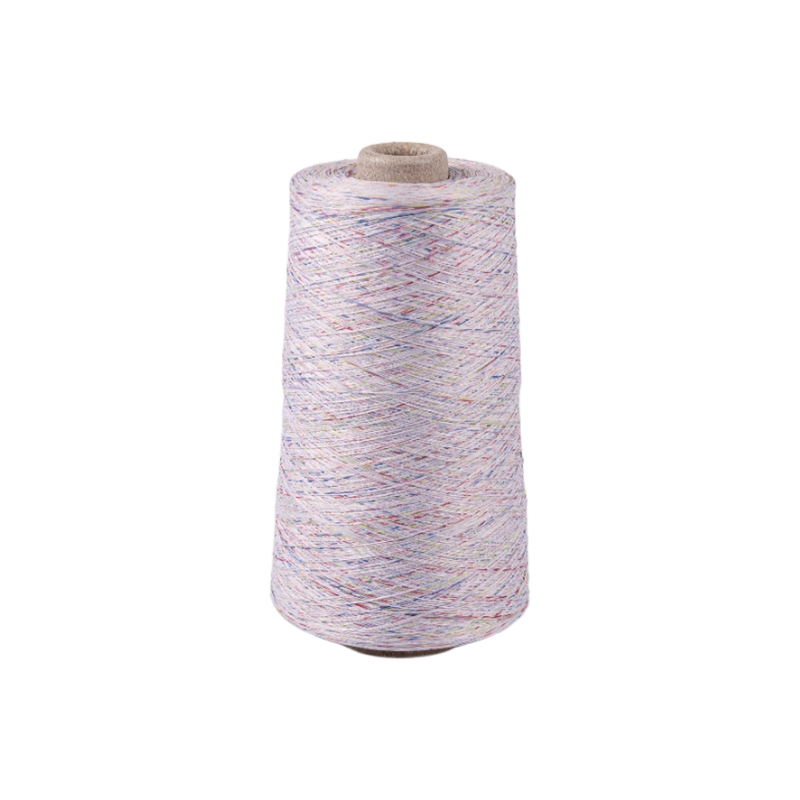 Space Dyed Yarn for Predictable Color CadenceWholesale space-dyed yarn in 120d/2, 150d/2, and 150/3, offering gradient color transitions for designs needing a repeatable color sequence rather than a blended heather look.View Product →
Buyers often compare samples that look similar but are made by different routes. The table below gives a practical overview of how the main methods differ.
| Method | Typical fibers | Color effect | Best use |
|---|---|---|---|
| Skein dyeing or hand painting | Wool, cotton, rayon, blends | Soft transitions, irregular repeats | Small lots, craft yarns, sample development |
| Knit-de-knit space dyeing | Polyester, nylon, cotton, acrylic | Clear bands, short to medium repeats | Machine knitting, embroidery, predictable stripes |
| Warp printing or pad-batch | Polyester, cotton, blended filament | Long repeats, high-volume color runs | Woven fabrics, broad stripes, industrial programs |
| Fiber blending before spinning | Cotton, wool, polyester, blends | Heather, melange, tonal texture | Soft surface interest rather than defined repeats |
The table is a starting point, not a rule book. A mill may combine methods, for example by printing a knit tube and then heat setting it to improve color fastness. The right route depends on the final fabric, the required repeat, and the dyeing equipment available.
Color repeat is where variegated yarn becomes a engineering issue rather than only a design choice. A short repeat may disappear into a fine gauge knit, while a long repeat may create obvious bands across a garment panel. For embroidery, the repeat affects how much thread is needed for a motif and how often the machine changes color. For flat knitting, it affects waste and panel matching.
A physical shade card and color swatch helps buyers compare the intended sequence under consistent light. It also gives the dyehouse a reference for repeat length, color depth, and acceptable variation before bulk production starts.
Variegation is not fiber-neutral. Polyester usually needs disperse dyes and high-temperature fixation. Cotton and rayon generally take reactive dyes, while wool often uses acid or reactive systems. Acrylic may be dyed with basic dyes. A blended yarn adds another layer of compromise because one dye bath may not color both fibers evenly.
This is why a dyer may adjust the method before adjusting the color. A polyester space-dyed yarn that needs strong wash fastness may be heat set after dyeing. A wool sock yarn may be handled more gently to preserve hand feel. A rayon embroidery thread may need careful washing to avoid dulling the luster. The fiber guides the chemistry, and the chemistry guides the production route.
Once the color is fixed, the yarn still has to prove that it will behave consistently in the customer’s process. A practical quality check usually covers the following points:
These checks are not separate from the dyeing method; they are part of it. A beautiful sample that cannot survive rewinding or washing is not a production-ready variegated yarn.
For buyers and product developers, the most useful habit is to specify the effect rather than only the color name. State the repeat length, the transition style, the fiber composition, the intended machine, and the expected fastness. Ask for a knitted or embroidered swatch, not just a cone sample. Then check how the yarn behaves under tension and how the color sequence falls across the finished piece.
It also helps to order enough yarn for the full production run from one dye lot. Variegated yarn can hide small shade differences in a skein, but those differences may become visible when several cones are knitted side by side. Good communication between the dyehouse, the knitter, and the finisher prevents most of the problems that appear late in the process.
If a softer, textured effect is part of the design, a space-dyed fancy yarn can add surface interest without losing the planned color rhythm.
 Space-Dyed Polyester Pom Pom Fancy YarnWholesale space-dyed polyester pom pom yarn described as toothbrush knitting yarn, for designs seeking soft surface texture while keeping a planned color rhythm.View Product →
In the end, variegated yarn is dyed by controlling interruption: stopping color here, allowing it there, fixing it in place, and repeating the sequence with enough discipline to make the next cone match the last. That balance between artistry and control is what makes a variegated yarn reliable in production.

How Does Embroidery Work? A Friendly Guide to Stitches, Threads, and Machines
2026-11-12
Needlepoint vs Cross Stitch: Canvas, Stitches, Threads, and Practical Differences
2026-11-19Your email address will not be published. Required fields are marked *
*Indicates a required field
Copyright © Shaoxing Qiufei Textile Technology Co., Ltd.  Custom Embroidery Thread Yarn Manufacturers